
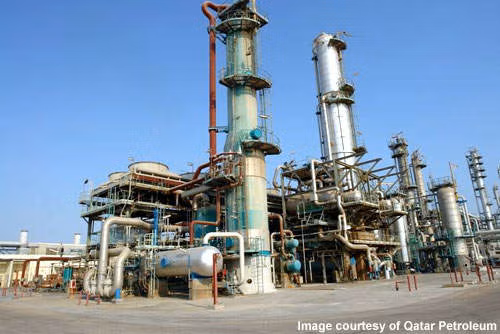
Al Shaheen Refinery, Mesaieed Industrial City
Industrial City of Mesaieed, Qatar
Designed around the problem.
Qatar refinery
“In May 2010 Qatar Petroleum announced that the Al Shaheen refinery project was to be postponed indefinitely.”
The Al Shaheen project was to be executed in two phases. The first phase was to involve the construction and operations of a hydrocracker and a crude distillation unit (CDU). The second phase included a fluidised catalytic cracking unit (FCCU).
Jacobs Engineering, in conjunction with Owotechnology, were the two companies that undertook the pre-front-end engineering and design (FEED) work on the Al Shaheen refinery project. In August 2007 Technip was awarded a lump sum FEED and project management contract for the refinery.
The contract, which was worth an estimated $60m, was undertaken by Technip’s Paris and Abu Dhabi design offices and completed by the third quarter of 2008.
Engineering that works in context.
Qatar Petroleum was to build a further grass roots refinery at Mesaieed Industrial City, Qatar, to process crude oil from the Al Shaheen field situated about 180km north of Doha and operated by Maersk Oil Qatar AS. However, in May 2010 Qatar Petroleum announced that the project was to be postponed indefinitely. The decision came after the project costs increased to more than $6bn.
The Al Shaheen field, which was discovered in 1992 and developed in 1994, produces over 260,000bpd, but has the potential for 400,000bpd over the next five years should demand and processing capacity allow (over $2.5bn has already been invested in the field).
The field’s crude oil production is currently taken by customers from a floating production storage and offloading vessel in the block 5 field. The field also produces gas, which is piped for use in Mesaieed-based facilities.
Part of the new refinery project was to involve the construction of an offshore and onshore pipeline to supply the new refinery. Qatar Petroleum said that the refinery was part of a plan ‘to increase crude oil production capacity from 850,000 to one million barrels a day’. In May 2010, however, Qatar Petroleum announced the postponement of the project indefinitely. The decision came after the project costs increased to more than $6bn.
Qatar Petroleum is instead planning to double the installed capacity at its 146,000bpd Ras Laffan, which was launched in September 2009. It will also concentrate on awarding contracts for a new refinery that will be similar to the Ras Laffan refinery by the end of 2010.